The procedure debugger at Barcelona's Provincial Council
On January 30, 1939, the Management Commission of the Barcelona Provincial Council was established, chaired by Josep M. Milà i Camps, Count of Montseny, who had been president of the Corporation between 1925 and 1930, during the dictatorship of Miguel Primo de Rivera. The commission was made up of Felip Batlló i Godó; Joan Claudi Güell i Churruca, Count of Ruiseñada; Àngel Traval i Rodríguez de Lacín; Lluís Rivière i Manén; Magí Raventós i Fatjó; Josep M. Segarra de Montoliu, and Josep Peray i March. The Management Commission was the collegiate body of the provincial councils between 1939 and 1949 and collaborated in the policy of deployment of the new Francoist state.
The new Management Commission put the Barcelona Provincial Council back into operation, which together with the Barcelona City Council, constituted the main institutions of the Regime in Catalonia, in the hands of the Catalan ruling classes allied with Francoism.
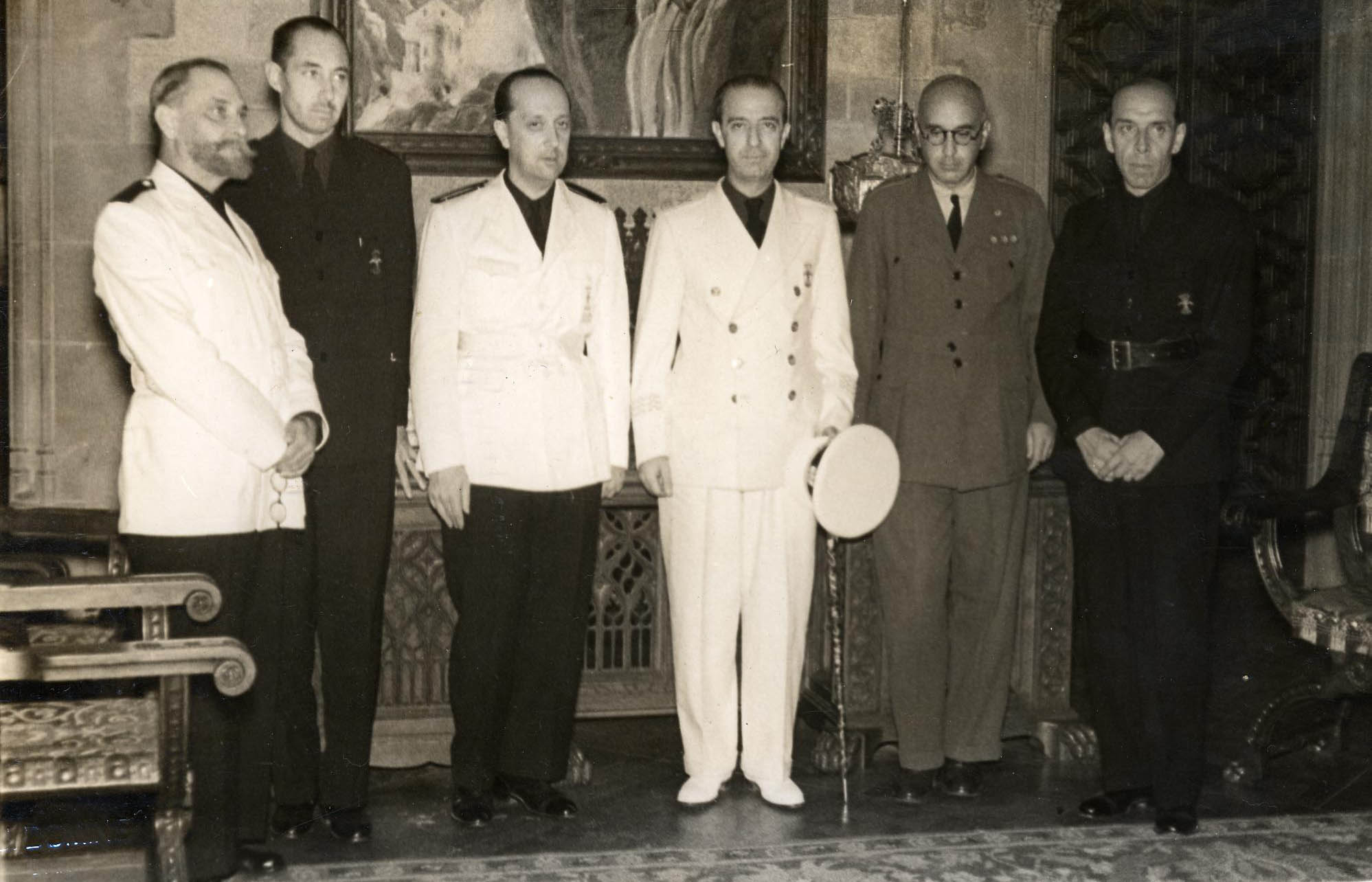
The president of the Provincial Council of Barcelona and of the Managing Commission Antoni Maria Simarro and Puig (second for the right), 18/09/1939. Authorship: Josep Domínguez. Fund: Barcelona's Provincial Council. (CAT AGDB R.10344)
The purge action was based on the Law of 10 February 1939 “setting standards for the purge of public officials”, which in its preamble stated: “The liberation of new territories, and especially that of Barcelona, a city that has been the headquarters of the Red Committee in recent times, raises with urgent urgency the problem of the purge of public officials.” The law provided for the initiation of investigations regarding public officials in the recently “liberated” territories, their relationship with the National Movement, and the imposition of sanctions “that correspond to the behavior of such officials and that are suitable for the good service of the State”. The Francoist legal framework established that the interested party had to prove their innocence, since the new regime considered everyone suspicious.
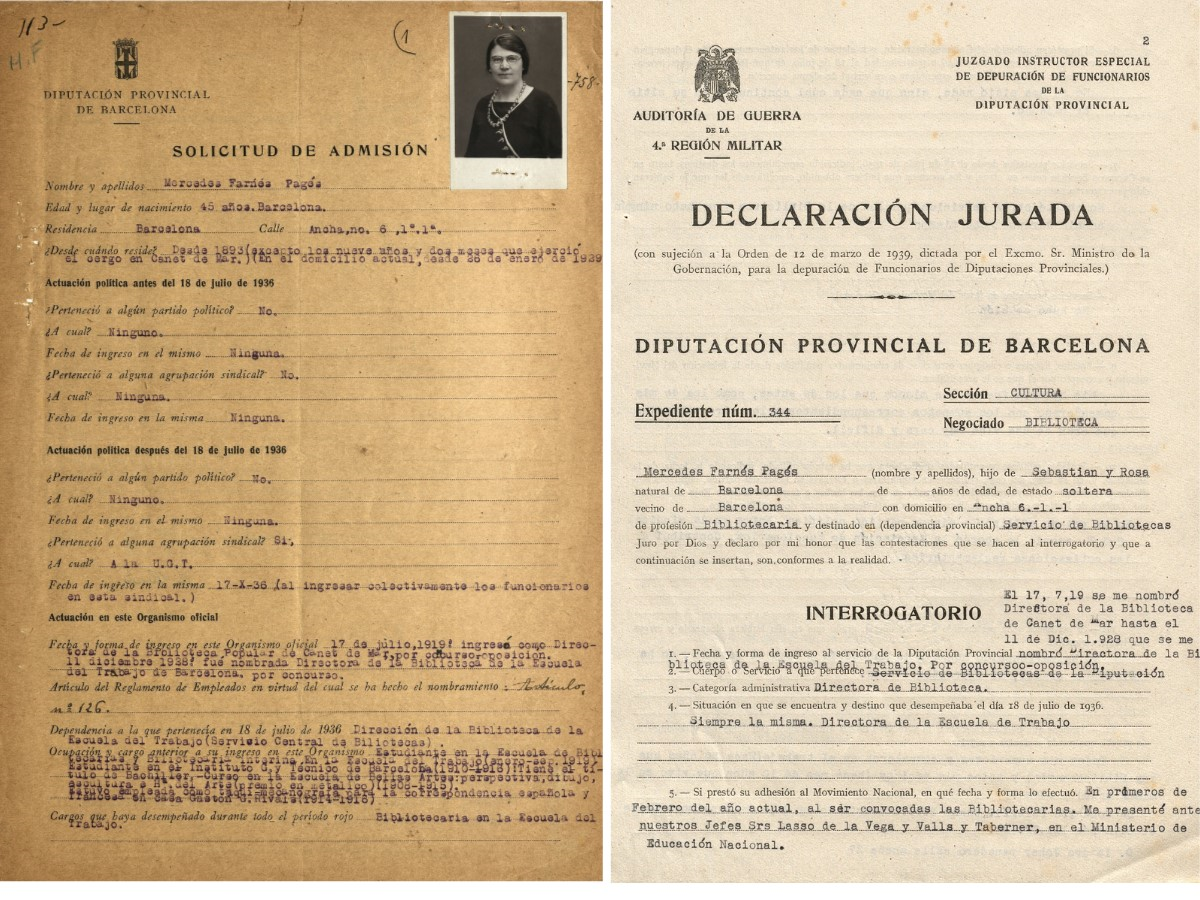
The first step was the submission by each civil servant of an application for admission (informing about their political actions before and after July 18, 1936, and their actions in the official body) and an affidavit, which consisted of a questionnaire where between 18 and 21 questions had to be answered, among others, the following: "If you pledged your allegiance to the Marxist Government or any of the autonomous bodies that depended on it or to the Red Authorities, after July 18, on what date and in what circumstances, specifying whether you did so spontaneously or under some coercion. Services rendered since July 18, 1936, indicating especially the destinations, both in his Body or Service and in others, and the promotions he had obtained, specifying those that had been due to rigorous seniority". These questionnaires-interrogatories of the affidavits did not always correspond to the same model form since two different models had previously been set. On the other hand, they also had to provide "Witnesses that can corroborate the veracity of your statements and proof documents that you can present or point to." Another question was added to the Provincial Council of Barcelona: "Tell me who were the most prominent left-wingers in your department and what you know about their actions."
Requests of admission of Mercè Farnés Pagés of the record of debugging, 1939. Fund: Barcelona's Provincial Council. (CAT AGDB ui 46 exp.344)
Based on this statement, the investigating judge began the investigations, which generally had as their most important part the reports from the Information and Investigation Service of the FET and the JONS, those from the police or Civil Guard, and those from the Military Police (SIPM).
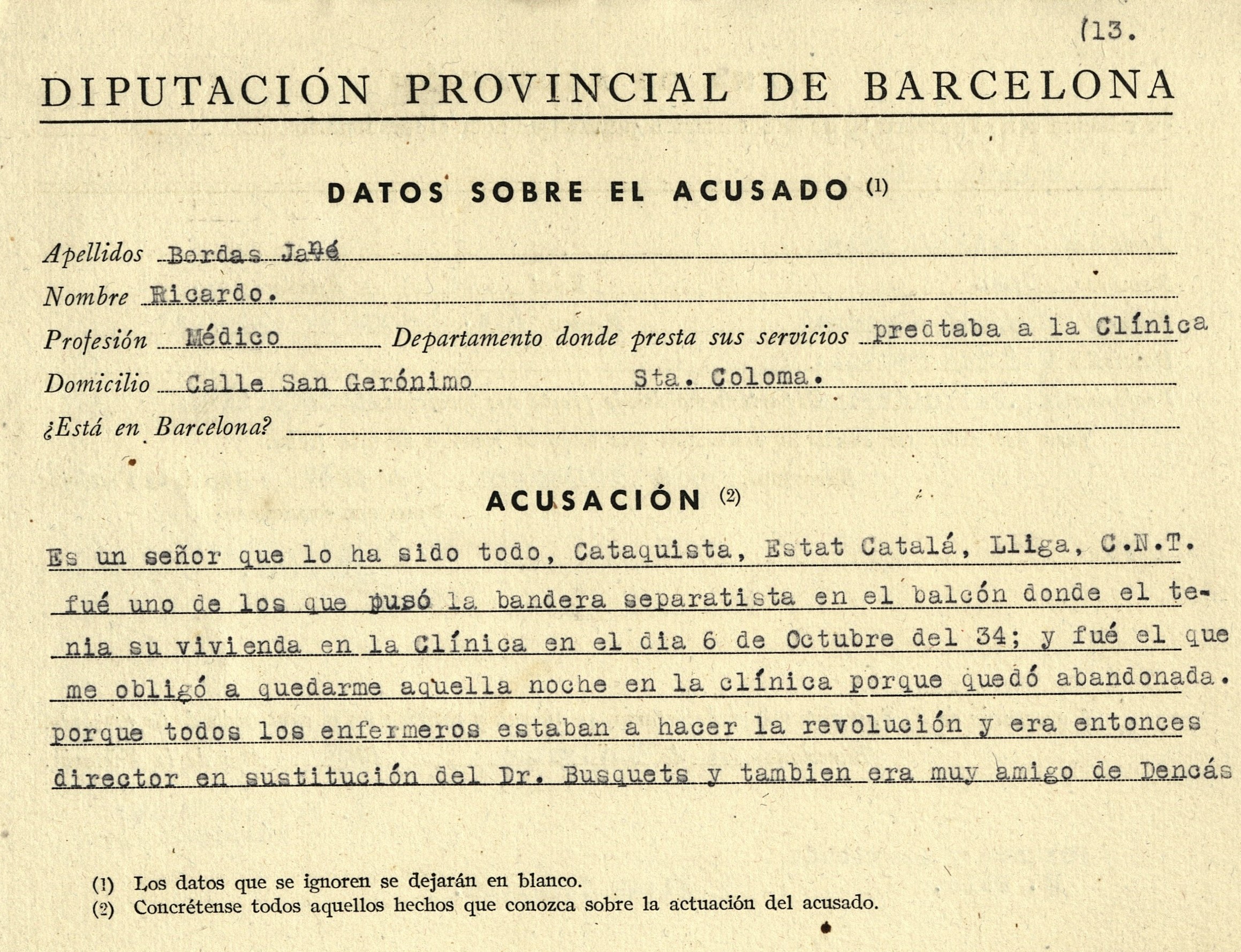
Chip of report of Ricard Bordas Jané of the record of debugging, 1939. Fund: Barcelona's Provincial Council. (CAT AGDB UI 46 exp.1198)
The Law recommended that the purge begin for those whose membership in the National Movement was unquestionable, with the dual intention that they could join the work quickly and at the same time “serve also as witnesses in other investigations”. Once the information was complete, the proposal for admission without sanction or the initiation of a case was formulated. In the latter case, the investigating judge formulated the list of charges and imputable elements that he communicated to the interested party, who had a period of eight days to present the statement of defence and demonstrate the falsity of the accusations made by providing all kinds of witnesses that confirmed their version of the facts. Finally, the investigating judge passed the case with his proposal to the Management Commission, which was the one who had to make the final decision. According to the Law of February 1939, the imposition of sanctions would be discretionary, although sufficient causes were indicated, ranging from those already prosecuted through criminal proceedings “all the facts that would have led to the imposition of penalties in the Military Courts or the requirement of political responsibilities, in accordance with the law of this name” to simple passivity “the evident passivity of those who could have cooperated in the triumph of the National Movement would not have done so”, or “actions or omissions that, without being expressly included in the previous sections, imply an anti-patriotic significance and contrary to the National Movement”. Sanctions could range from admission with disqualification from positions of trust to dismissal. The ministerial order of March 12, 1939 developed some of the previous rules in accordance with the specific characteristics of local administration and expanded the range of sanctions. Sanctioned officials could appeal to the Minister of the Interior.
Listing of functionaries sanctioned of Barcelona's Deputation, 1940. Fund: Barcelona's Provincial Council. (CAT AGDB UI 47 exp. 5)
After the war, the legislative and legal machinery of the new Francoist state accelerated: in August 1939 the purge process was launched. The Management Commission, the governing body of the Barcelona Provincial Council between 1939 and 1949, appointed Juan Amat y Vidal as the examining judge for purge cases. In September 1939, Salvador Viada López-Puigcerver, lawyer and captain of the Military Legal Corps of the IV Military Region, replaced Juan Amat y Vidal in the position.
The purge process was carried out in a short period of time, since it was necessary to re-establish institutional functioning with a staff that predated 1931 or the early days of the Republic.